


As AI moves from pilot projects to enterprise-wide deployment, adoption is accelerating — with 88% of organisations now using AI regularly in at least one business function.
But readiness is lagging behind ambition. Nearly 87% of organisations have delayed AI deployments by almost six months because of data security and data management risks, underscoring that AI alone cannot overcome gaps in governance, data quality, and operational readiness.
Strong foundations across data, applications, infrastructure, and knowledge are essential for scaling AI across the organisation. This blog post explains why they are crucial to achieving ROI from AI and introduces the AI-to-ROI autonomous loop, a framework designed to help organisations measure, govern, optimise, and continuously realise business value from AI investments.
AI Amplifies Existing Business Conditions
AI doesn't redesign inefficient workflows, resolve fragmented data, or establish governance on its own. It accelerates existing processes and decisions, often at greater scale and speed. In fact, according to McKinsey, some Fortune 250 companies are already seeing campaign creation and execution speed up 15-fold, through AI agent utilisation.
However, as adoption expands, underlying operational strengths and weaknesses become more visible. AI does not solve concerns on disconnected systems; it amplifies them. AI-powered insights will produce inconsistent and inaccurate data due to system fragmentation. Autonomous agents will inherit excessive permissions, duplicate work, or make decisions without sufficient oversight.
Organisations must strengthen the data, governance, and operating controls that AI depends on, so greater speed produces more consistent and trustworthy outcomes.
The Shift From AI Deployment to AI Outcomes
According to AvePoint’s State of AI 2026 Report, 86.3% of organisations now expect an ROI within 12 months or less, up from 81.9% a year earlier.
However, while the number of copilots deployed, AI agents created, or use cases launched indicates activity, it doesn't necessarily demonstrate business value.
Success is measured by the business outcomes AI helps achieve: work accelerated, productivity improved, risks reduced, and value created. The sharper way to frame ROI is not what an agent costs to run, but what it delivers. An AI agent that costs a few dollars yet removes hundreds of dollars of manual effort is a clear win, even if it looks expensive on an IT invoice.
But to achieve true ROI, organisations must maintain visibility into AI adoption, governance, and operational performance — ensuring that AI doesn’t just become another technology investment, but a capability that continuously improves the business through accurate and complete data analysis. According to McKinsey, 92% of organisations plan to increase AI investment over the next three years, however, only 1% describe their AI deployments as mature in the context of full integration into workflows and driving positive business outcomes.
Reinforcing the 5 Foundations of Intelligence
Because AI magnifies whatever it is built on, the quality of your foundations determines whether that amplification works for you or against you. The blockers to enterprise AI are rarely the models themselves — they are the internal conditions the technology depends on.
Many organisations are attempting to scale AI before establishing the pillars that enable trustworthy outcomes. Gartner found that 63% of organisations either do not have, or are unsure they have, the right data management practices in place for AI.
The value AI can create comes from five interconnected layers:
- Data: Trustworthy, governed, and accessible, so AI outputs can be relied upon
- Applications: Connected and approved, so insights aren’t fragmented across disconnected systems
- Infrastructure: Secure and resilient, so AI performs reliably under real-world conditions.
- Knowledge: Centralised and contextual, so AI draws on the right organisational understanding
- AI: The models and agents that act on all the above, only as strong as the layers beneath them
Strengthen these layers and amplification becomes an advantage. When these foundations are overlooked, AI can magnify operational challenges and create additional complexity at scale.
Introducing the AI-to-ROI Autonomous Loop
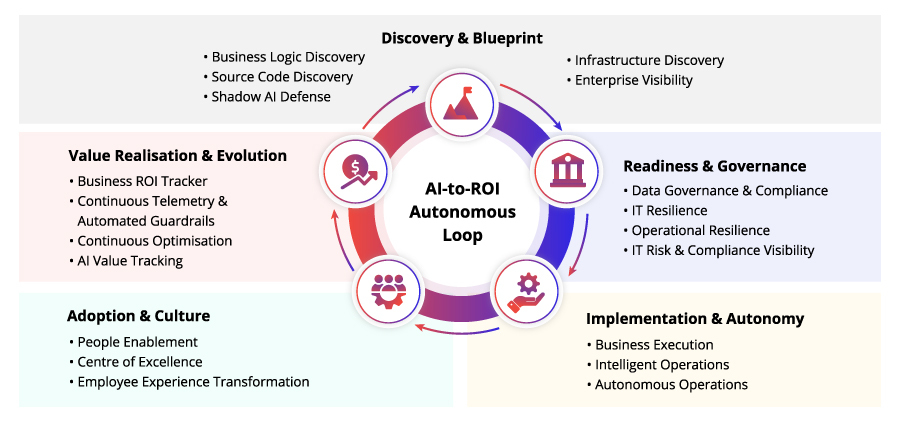
Rather than viewing deployment as the finish line, organisations should approach AI as an ongoing operational discipline. This thinking underpins the AI-to-ROI autonomous loop, a framework that helps organisations move from strategy to implementation through governance, optimisation, and autonomous operations, while maintaining focus on measurable business outcomes.
The 5 Phases of the Loop
- Discovery & Blueprint. Map out where AI can genuinely add value, then surface hidden risks, like shadow AI, before they scale.
- Readiness & Governance. Get your data, controls, and operations in order so AI can run safely and reliably as it grows.
- Implementation & Autonomy. Put AI to work across the business, from everyday execution to intelligent, autonomous operations.
- Adoption & Culture. Bring your people along, building the skills, support, and experience that make AI adoption stick.
- Value Realisation & Evolution. Track the return, keep AI within guardrails, and continuously optimise so value grows over time.
Why “Continuous” Is the Point
The loop is deliberately circular. Measuring, governing, and optimising on an ongoing basis is what keeps each initiative delivering value long after go-live. Continuous telemetry and automated guardrails give leaders the observability to tie AI spend to outcomes; continuous optimisation ensures the business keeps improving rather than plateauing once a project ships. Deployment is the start of the value journey, not the end of it.
From AI Ambition to Measurable Business Value
As enterprise AI matures, success can no longer be measured by the number of copilots or agents deployed. Business value from AI depends on strong foundations across data, applications, infrastructure, and knowledge, connected through a loop that keeps measuring, governing, and optimising AI’s performance in the organisation.
AvePoint helps organisations AI ROI with a connected approach spanning strategy, implementation, governance, and autonomous operations. By strengthening the foundations that AI depends on, organisations can convert AI investments into measurable business outcomes.
For Singapore-based organisations, the Enterprise Compute Initiative (ECI) AI Accelerator offers an opportunity to accelerate that journey. Eligible organisations may access up to S$105,000 in funding support to strengthen data readiness, deploy Copilot and agentic AI responsibly, and scale high-value use cases with confidence.
Explore the programme and check your eligibility today.


Grace Zhang is a solutions director at AvePoint Singapore, representing our consulting services with a deep focus on driving digital transformation across government services, citizen engagement, and the healthcare sector. With extensive experience in solution design and client advisory, Grace works alongside public agencies and enterprises to modernise service delivery, elevate user experience, and ensure digital initiatives are aligned with strategic business objectives.